

The Problem TAC Solves
For EVM Developers
Challenge: Reaching TON’s billion users requires rebuilding entire applications in FunC, TON’s native language.
TAC Solution: Deploy existing Solidity contracts as-is and make them accessible to TON users
For TON Users
Challenge: Limited access to DeFi, gaming, and other EVM applications that dominate the blockchain space.
TAC Solution: Use any EVM application directly from TON wallets without bridges or multiple wallets
How TAC Works
TAC operates through three core innovations that work together seamlessly:Layer 1 EVM Blockchain
Layer 1 EVM Blockchain
TAC EVM Layer is a CosmosSDK-based blockchain that runs unmodified Solidity contracts and achieves ≈2-second finality through dPoS. This means:
- Deploy existing Solidity contracts without modifications
- Use familiar tools like Hardhat, Remix, and MetaMask
- Built on proven Cosmos SDK with Tendermint consensus
- Secured by delegated Proof of Stake with economic incentives
- Future Enhancement: Babylon Bitcoin restaking for additional economic security
TON Adapter
TON Adapter
A distributed network of sequencers that securely routes messages between TON and TAC EVM:This isn’t a traditional bridge — it’s a purpose-built messaging system designed for hybrid applications.
- Validation: Sequencers verify all transactions and asset transfers
- Consensus: 3/5 sequencer consensus with BFT guarantees
- Security: Multiple validation layers prevent double-spending and fraud
- Epochs: Time-based processing ensures orderly message handling
Current Network Status: The sequencer network is currently distributed but not decentralized. Full decentralization is on the roadmap as the network matures.
Proxy Smart Contracts
Proxy Smart Contracts
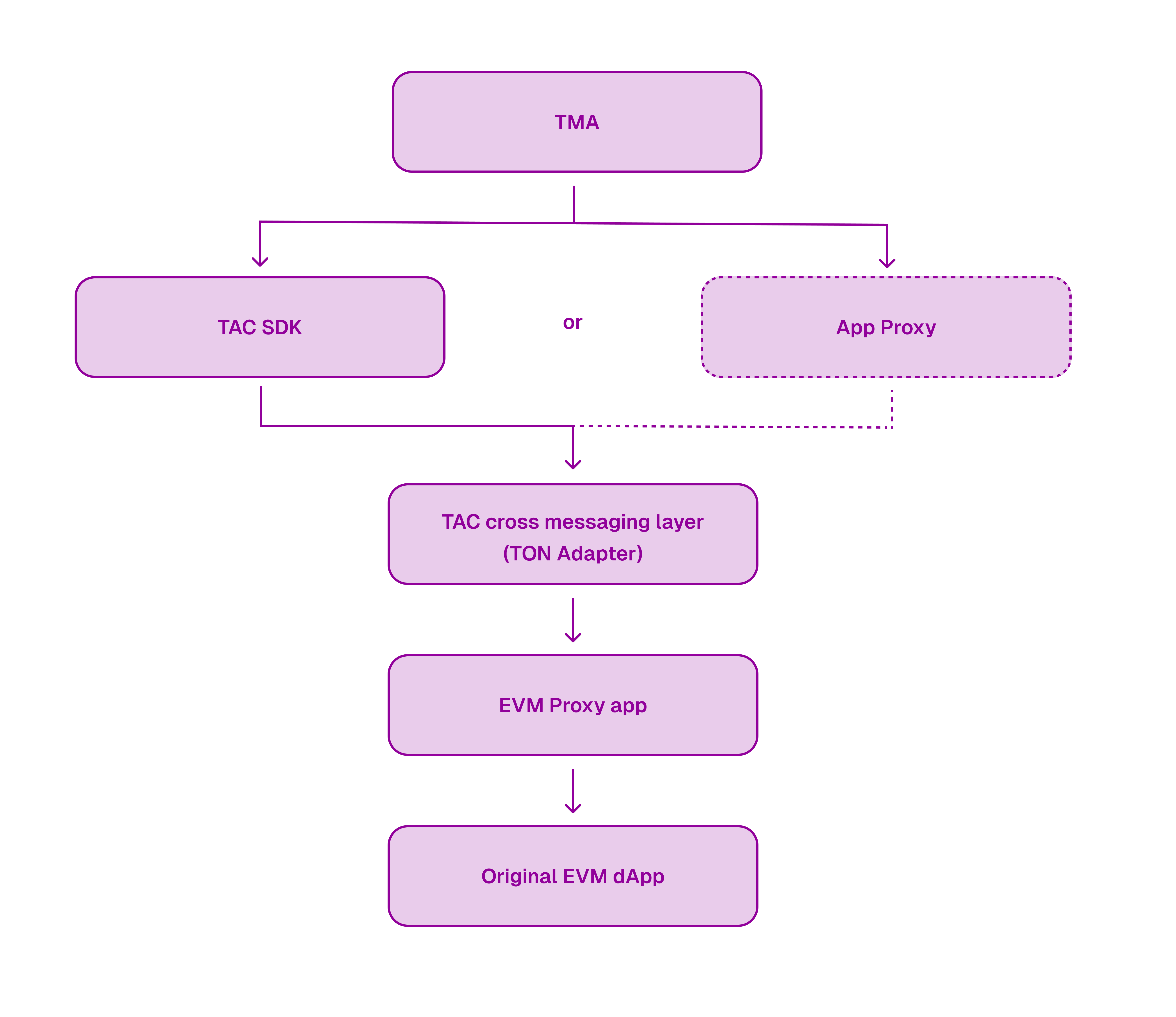
Specialized contracts that make cross-chain interaction feel native:On TON: SDK handles proxy logic automatically
On EVM: Solidity contracts receive and process cross-chain messagesWhen a TON user interacts with an EVM app, proxy contracts handle all the complex routing, asset management, and message formatting behind the scenes.
On EVM: Solidity contracts receive and process cross-chain messagesWhen a TON user interacts with an EVM app, proxy contracts handle all the complex routing, asset management, and message formatting behind the scenes.
Key Benefits
- For Developers
- For Users
- For Ecosystem
Deploy Once, Reach Billions
- No code rewrites: Deploy existing Solidity contracts directly
- Familiar tooling: Use Hardhat, Truffle, Remix, and other EVM tools
- Hybrid dApp conversion: Every deployment becomes a Hybrid dApp accessible from TON
- Cross-chain SDK: Simple JavaScript library handles TON integration
- Telegram MiniApps: Bring EVM-powered logic directly inside Telegram
Transaction Flow Example
Here’s what happens when a TON user swaps tokens on an EVM DEX through TAC’s hybrid dApp system (like Curve):TAC SDK encoding
The TAC SDK implemented within DEX frontend conveniently encodes required EVM calldata for the upcoming swap on the TAC blockchain
and brings up the prepared transaction for user to approve.
Sequencer Validation & Consensus
Sequencer network finds and validates the transaction, forms Merkle trees, reaches
consensus across multiple groups, and selects the executor. The final decision in set within the TAC blockchain.
EVM Execution
A designated executor scans and finds the transaction to execute, validates its Merkle proof, triggers asset
minting/unlocking, and calls the swap on the target DEX contract on TAC.
What Makes TAC Different
Unlike traditional bridges that move assets between existing chains, TAC creates hybrid applications that natively serve both ecosystems. Users don’t “bridge to another chain” — they use applications that happen to run on EVM but feel completely native to TON. This fundamental difference enables:- Seamless UX: No wallet switching or manual bridging
- Unified liquidity: Assets flow where they’re needed most
- Developer efficiency: Build once, serve both ecosystems
- Network effects: Growth in one ecosystem benefits the other